INTRODUCTION
Many ancient deity names from North Africa carry origins that remain uncertain. Modern scholarship often classifies these names as Phoenician, Egyptian, or later Greek without examining the linguistic landscape of the region itself. This tendency exists partly because those civilizations left more written material, while Amazigh (often known as “Berber”) languages have been historically underrepresented in academic etymologies.
Yet Amazigh dialects preserve some of the oldest and most stable verb structures in the Mediterranean. These verbs frequently form names, titles, roles, and symbolic identities. Inside Amazigh culture, the connection between a root, an action, and a being is direct and natural. A name can simply be the verb describing what the person or entity does.
This article explores whether several well-known deities found in Amazigh territories, such as Tanit, Amun, Baal Hammon, and Neith, and even certain Greek figures like Athena and Poseidon, may reflect Amazigh verb-roots still alive today. When the consonantal pattern of the name matches an Amazigh verb, when the meaning aligns with the deity’s function, and when the iconography visualizes the action of that verb, a coherent reading begins to appear.
The goal is not to replace established interpretations but to open a parallel line of inquiry based on linguistic continuity, geographic presence, and symbolic logic rooted in Amazigh culture.
SECTION 1 — THE METHOD
The approach used in this study is simple and repeatable.
It follows a sequence of linguistic and contextual checks.
1. Identify the consonantal root of the name
Amazigh verbs and nouns rely on stable consonantal frames.
The goal is to isolate this backbone before comparing it to Amazigh morphology.
Example:
Tanit → T-N-T
This frame is what we evaluate in the next steps.
2. Check whether this consonantal structure exists as a verb-root in Amazigh
Amazigh dialects preserve verb patterns consistently across regions.
If the consonants match a known root, it becomes a candidate for comparison.
3. Compare the verb’s meaning with the deity’s traditional role
The semantic field must align.
If the action encoded by the verb reflects the deity’s known function, the match gains weight.
4. Examine iconography for visual echoes of the verb
Symbols often preserve older layers of meaning.
A match between the verb’s action and the deity’s imagery strengthens the hypothesis.
5. Confirm geographic and cultural plausibility
The name must appear in regions where Amazigh languages or influence existed —
or in contact zones where linguistic exchange was possible.
6. Draw conclusions only when several layers align
A candidate is accepted only when:
- the Amazigh root exists,
- the meaning fits the deity’s role,
- the iconography echoes the action,
- and the geographic context supports contact.
This step-by-step process defines what I call the Verb–Deity Method, a practical tool for reevaluating ancient names and symbols in North Africa.
Classical Distortions of Amazigh Names: Jugurtha and Masinissa
Greek and Roman writers often reshaped Amazigh names to fit their own phonetic rules.
Two well-known examples show this clearly:
Yugurthen → Jugurtha
(loss of initial y-, smoothing of -rthn, added final -a)
Masnsen → Masinissa
(simplification of ns-ns, vowel insertion, double -ss- added)
Both names are originally Amazigh verb-based identities, consistent with the verb-centered structure of Amazigh grammar:
-
Yu-gur-then = “he is greater than them / he surpasses them”
(from the root gr/ gṛ “to surpass, be greater”) -
Mas-nsen = “their lord / their master”
(mas = chief, n-sen = of them)
This demonstrates two key points:
-
Amazigh personal names were built from verbs, the same pattern argued for deities.
-
Classical distortions regularly obscured original consonantal structures.
If royal names were reshaped this consistently, sacred names could undergo the same process.
This gives a reasonable context for exploring whether names such as Tanit, Athena, or Poseidon preserve modified forms of older Amazigh verb-roots.
SECTION 2 — Tanit: The Verb “She Saw”
Tanit offers the clearest case of a Mediterranean goddess whose name aligns with an Amazigh verb-root describing sight, perception, and protective awareness. The linguistic form, the symbol, and the geographic distribution all point toward a native North African origin.
A) The Amazigh Verb
In Tachelhit and other Amazigh dialects, the base term for “seeing” appears as:
-
annay = “the look,” “the act of seeing,” “to see” (neutral, not conjugated)
When Amazigh derives or conjugates this stem, the leading A- drops and the consonants reduce to:
-
N-T / N-Y
This is a normal reduction pattern in the language.
The feminine verbal frame T … T is a standard Amazigh morphological device.
From annay, the feminine action-form becomes:
ta-n…-t → tanit / tannit = “she saw / she perceives.”
This form is still visible in modern Tachelhit expressions such as:
- tanit / tanith — “she saw it”
- matanit / ma-tanit — “what did you see?”
- artanayt / artanit — “you are seeing”
-
ar-tanay — “she sees”
The name Tanit therefore matches a living Amazigh verbal structure.
B) The Name Tanit / Tinnit / Tanith
Ancient writers recorded several forms:
- Tanit
- Tanith
- Tinnit
- Tannit
- Tinith
- Tinnitum
-
Thinit
These reflect Punic spelling, Greek transcription, and Libyco-Berber pronunciation.
Despite the variation, they all preserve the same consonantal frame:
T-N-T
The doubled N in Tannit or Tinnit fits Amazigh nasal-root behavior, where internal consonants often strengthen in verbal or feminine forms.
Structurally, all forms remain consistent with a feminine Amazigh verb meaning:
“she saw / she perceives.”
C) Symbol Analysis: The Tanit Symbol Encodes Sight
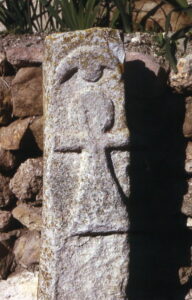
Tanit’s symbol, found across Carthage and North Africa, is traditionally interpreted as a stylized anthropomorphic form with a crescent. A closer reading suggests a direct visual representation of seeing.
1. Crescent With Central Pupil = Eye
Many stelae show:
- a crescent
- a dot-like pupil placed within or under the curve
When the crescent is oriented downward, the shape becomes identical to an eyelid with a pupil.
This matches the function encoded by the verb tanit (“she saw”).
2. Human Figure Below = Object Being Seen
The triangular body under the “eye” forms a schematic human figure.
In this reading, the symbol shows:
- the eye of Tanit
- seeing the human world
rather than a moon over a human.
The triangular figure with a simple head cannot represent Tanit herself. Punic art did not depict deities as crude human stick-figures; in other regions, Tanit appears with hair, a crown, or even an animal-headed form, while this minimal shape matches the posture of a human worshipper with raised arms. It represents ordinary humanity offering prayer beneath the divine sign above. The upper symbol expresses Tanit’s presence, and the lower figure is the human world under her gaze.
The symbol can be read as:
Tanit looking down at the people she protects.
This aligns the symbol, the verb-root, and the role.
D) Tanit as a Protective Watching Goddess
Carthaginian inscriptions portray Tanit as a deity who:
- protects
- oversees
- responds to requests
-
grants blessing
These actions relate to awareness and perception.
The Amazigh verb tanit = “she saw / she notices / she oversees” fits this functional field naturally.
In Amazigh cosmology, protective female beings often work through vigilant presence rather than force.
Tanit fits comfortably in this pattern of watchful guardianship.
SECTION 3 — Amun / Ammon / Baal Hammon: The Verb “To Accompany”
Amun is widely known as an Egyptian god with a long theological history, yet the regions that preserved his most important cult outside Egypt were Amazigh territories, especially the Siwa Oasis. When his name is examined through Amazigh verb-roots, a consistent pattern appears. The consonantal frame of his name matches a living Amazigh verb whose meaning aligns directly with his mythological role. Baal Hammon, worshipped across Carthage and the Maghreb, belongs to the same root-family and expresses the same function. Both gods can be understood through the same linguistic and symbolic structure.
A) The Amazigh Verb: M-N = To Accompany
Across Tachelhit and several Amazigh dialects, the root M-N expresses companionship and collective movement. It appears in everyday speech with stable meaning:
- imun = he accompanies
- imon / imun didi = he goes with me
- nmun = we accompany each other
- anmun = we will go together
-
asmun = company, group moving together
The core meaning remains clear:
M-N = accompany, go with, be in company, move together.
This semantic field is ancient and consistent across dialects.
B) Names and Variants: Amun, Ammon, Hammon
Ancient sources record the god’s name in several forms:
- Amun
- Ammon
- Amon
-
Hammon / Hamun (Libyco-Punic form)
Greek writers often transcribed it with an initial aspiration:
- Ἄμμων (Ammon)
-
Ἁμμων (Hammon)
These variations do not change the consonantal root.
They all reduce to M-N, identical to the Amazigh verb.
Egyptologists often translate Amun as “the Hidden One,” from Egyptian mn / imn. The Amazigh reading adds an underlying action-based layer:
Amun = the one who accompanies.
This meaning becomes plausible if the Egyptian root MN shares an older Afro-Mediterranean origin with the Amazigh M-N family of verbs denoting movement and accompaniment. Ancient Egyptian and Amazigh are sister branches of the Afroasiatic language family, so shared ancestral roots are expected. In this view, “the Hidden One” may reflect a later theological interpretation of a root that originally described a guiding or accompanying presence.
This interpretation is compatible with New Kingdom portrayals of Amun as a hidden force traveling with the sun.
C) Ritual and Symbolic Role: A Deity of Companionship
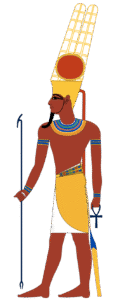
Amun’s presence in Egyptian cosmology centers on movement and pairing:
- he travels with the sun
- he guides the solar bark through the unseen realm
- he stands beside Ra
- he stands beside the king
-
he forms a triad with Mut and Khonsu
Amun rarely appears alone.
He is always with someone or something.
This is the exact semantic field of the Amazigh root M-N.
His plumed crown also reinforces this idea. The dual vertical feathers reflect a paired structure. A deity defined by pairing and accompaniment fits the verb-root seamlessly.
Through an Amazigh linguistic lens, the crown becomes a visual code: Amun is the one accompanying the sun.
D) Geography: Siwa Oasis as the Heart of the Cult
Amun’s most important sanctuary outside Egypt was located in the Siwa Oasis, an ancient Amazigh-speaking region. Classical authors describe:
- Amazigh priests
- Amazigh ritual customs
-
a Libyan interpretation of the god
Thebes remained the unrivaled center of Amun’s cult.
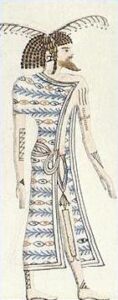
Egyptian art depicts Western Libyan figures with double feathers, the same dual motif later formalized in Amun’s crown. This visual parallel suggests a Western Desert origin for the plume-symbol, reinforcing the possibility of deep cultural exchange between Libyan populations and early Amun theology.
The Libyco-Punic form Hammon continues the same M-N root across Carthage and the wider Maghreb regions where Amazigh languages were spoken for millennia.
A geographical chain emerges:
Thebes → Siwa (Amazigh) → Carthage (Amazigh)
The linguistic consistency follows the same path.
E) Baal Hammon: The Companion God of Carthage
Baal Hammon is often treated as a purely Phoenician deity. When his name is examined through the consonantal method and placed in its North African environment, he aligns with the same verb-root as Amun.
1. Name Structure
Hammon, Ammon, Hamun, Ammun
→ all variants of M-N
→ all compatible with Amazigh M-N = accompany
The initial H- is a Punic or Greek transcription element and does not alter the root.
2. Iconography
Baal Hammon is frequently depicted:
- seated on a throne
-
flanked by two sphinxes
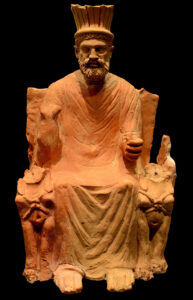
The double-sphinx arrangement expresses:
- accompaniment
- guardianship
-
presence on both sides
This visual pairing echoes the same root:
nmun = they accompany each other
The throne scene becomes a visual statement of the verb.
3. Function
Baal Hammon is described as:
- protector of the city
- paternal figure
- guardian of the community
-
presence at collective events
These roles fit the idea of a deity who goes with the people.
Baal Hammon is not an isolated sovereign.
He is a companion deity, mirroring the core meaning of Amun.
F) Alignment of Verb, Name, Symbol, and Geography
1. Linguistic Root
M-N = accompany, go with, be in company.
2. Names
Amun / Ammon / Hammon = same consonantal frame.
3. Iconography
paired feathers, paired sphinxes, paired deities.
4. Function
solar companion, royal companion, companion of the city.
5. Geography
Amazigh Siwa, Amazigh Carthage, Libyan sphere.
This combined pattern presents Amun and Baal Hammon as two expressions of the same underlying deity whose identity is encoded in the Amazigh verb-root M-N.
Amun–Hammon = the accompanying god.
SECTION 4 — Athena: A Libyan “She-Who-Sees” Goddess Rooted in the Amazigh Verb Arthanay
Among all Mediterranean goddesses, Athena is one of the rare figures whose origin the Greeks themselves place outside Greece. Several classical sources situate her birthplace near Lake Tritonis in Libya — deep within Amazigh-speaking regions. Her name lacks a clear Greek etymology, and her earliest cult is consistently tied to North Africa.
This makes her an ideal candidate for applying the Verb-Deity Method.
A) Amazigh Verb-Root Link: Arthanay (“She Sees”)
In the Tachelhit dialect (Aït-Baha region), the verb arthanay / artanay means:
“she sees”
(third person feminine, present tense)
It follows an Amazigh verbal template AR-…-AY that activates the root in an action form. Within this family, the form arthanay functions as the feminine ‘she sees.’ This is the living form of an older root also seen in:
- annay = “look” / “the act of seeing”
- anin = “look in”
-
artanay = “she sees”
The root AN is active and stable in this structure. When expressed through the AR-…-AY frame, it becomes arthanay, literally ‘she sees.’
Rather than implying that Athena is a direct preservation of the spoken verb arthanay, it is more accurate to understand arthanay as the semantic force-name behind the goddess’s identity. In Amazigh linguistic logic, verbs frequently generate roles, agents, and identities rather than remaining bound to grammatical tense. The force expressed by arthanay—active feminine perception, vigilant awareness, and clear sight—could naturally stabilize as a divine name when transmitted across cultures. As this North African seeing-force entered the Greek world, its phonetic form was adapted to Greek sound patterns, producing Athēnā, while its defining function as a goddess of foresight, strategy, and lucid perception remained intact. The adaptation preserves meaning first, form second.
B) Function First: Athena as the Goddess Who Sees
Athena’s divine function is rooted in vision and clarity. She is consistently depicted as:
- the strategist who foresees outcomes
- the protector who sees approaching threats
-
the counselor who sees inner truth
These are not symbolic traits. They are literal expressions of perceptual power; her sight defines her role.
This matches directly with the verb arthanay — “she sees.”
C) The Epithet Glaukopis: Clear-Eyed or Clear-Seer?
Athena’s famous epithet glaukopis is often translated as “grey-eyed,” or “bright-eyed,” but its components suggest active sight:
- glauk- = bright, gleaming, sharp (often associated with alert or piercing sight)
-
-op- = sight, gaze, eye
The literal meaning is:
“she who sees with sharp clarity”
“the one with a piercing, radiant gaze”
This again frames Athena not as beautiful, but as one who sees. A divine title built on active vision, just like arthanay.
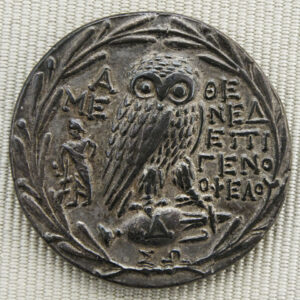
The owl, known for its sharp and watchful eyes, echoes Athena’s defining trait, seeing clearly. The second element is the olive, a staple of Amazigh land culture.
D) Geographic Continuity: Athena’s Libyan Origin in Ancient Sources
Classical authors, including Herodotus and Diodorus, locate Athena’s roots in Libya:
- Worshipped by Libyan women
- Armored figure linked to local tribes
- First shrine beside Lake Tritonis
-
Tied to Neith, another deity with strong Libyan roots
This places the earliest Athena cults in Amazigh-speaking territory, where the verb arthanay is still used.
E) Alignment With Tanit: A Shared Lineage of Seeing Goddesses
Athena and Tanit both reflect:
- feminine verb structures built on vision (T-N-T, Th-N)
- protective and overseeing roles
- symbols involving the eye or watchfulness
-
origins on the southern Mediterranean rim
Tanit = “she saw”
Athena = “she sees”
The verb roots tanit and arthanay belong to the same living verb family:
- ANNAY = to look / to see
- TANIT = she saw
- ARTHANAY = she sees
-
→ ATHENA
Conclusion of This Section
This chain shows continuity, a regional divine function expressed through Amazigh verb forms.
Athena’s unclear Greek etymology, her accepted Libyan birthplace, her explicit function as a seer and strategist, and her semantic and phonetic proximity to the Amazigh verb arthanay (“she sees”), together reinforce a simple, grounded idea:
Athena is a Hellenized echo of a North African “she-who-sees” goddess.
Her name, like Tanit’s, may descend from a living verb-root that still breathes in the Amazigh mountains of today.
This makes her one of the strongest case studies in the Verb-Deity Method, restoring the voice of a forgotten linguistic and spiritual lineage.
SECTION 5 — Poseidon: “The One Whose Waters Shake”
Greek tradition places Poseidon’s earliest cults in Libya, inside Amazigh cultural territory, long before the Greeks turned him into a maritime deity. His oldest identity is rooted in rivers, torrents, flood-waters, and the violent movements beneath the earth. When read through Amazigh hydronyms and verb morphology, his name aligns with a clear, action-based structure.
A) The Amazigh Hydronym Asif: Torrent, Boundary Water, Violent Flow
Across Amazigh dialects, asif / assif denotes:
- a river
- a torrent
- strong running water
-
water that breaks or reshapes boundaries
This is not calm water. It is water that moves, shakes, destroys, and transforms.
This field of meaning already fits the natural world associated with Poseidon.
B) The Amazigh Verb Root D-D / Dd: Shaking, Trembling, Violent Motion
In Tachelhit and related dialects:
- iṯdodo / iṯdodon = “it is shaking,” “it is being shaken”
- ariṯdodo = “he is being shaken”
- issdodi = “it shakes violently”
-
znzal issdodi akal = “the earthquake shook the land”
This root describes:
- earthquakes
- shaking ground
- trembling structures
-
violent movement of natural forces
These meanings are central to Poseidon’s identity, the earth-shaker.
C) The Amazigh Compound Bo-Assif-Iṯdodon: “The One Whose Waters Shake”
Amazigh morphology gives a direct structural match.
Bo / Bu / Bw-
= “the one who owns,” “the one defined by,” “lord of”
This prefix remains productive in modern Amazigh. For example:
– bo-tgmi / botgmi — “owner of the house”
– bo-akal / bowakal — “owner of the land” (pronounced bowakal in rapid speech)
– bo-aghad / bowaghad — “owner of goats” (bowaghad in rapid speech)
The construction expresses possession, mastery, or definition, the same structure reflected in Bo-Assif-Iṯdodon (“the one whose waters shake”).
Asif
= torrent, river, violent strong water
Iṯdodon
= shaking, trembling, violently moving
Combined:
Bo-Assif-Iṯdodon
= “the one whose river/torrent is shaking”
= “the lord of trembling waters”
= “the one who commands violent water-movement”
This identity aligns perfectly with Poseidon’s primordial function:
- god of earthquakes
- god of flood-waves
- god of shaking seas
- god of violent natural motion
-
god of earth-tremors from underground water
Poseidon is not the god of gentle coasts; he is the god of dangerous motion.
This Amazigh construction encodes that action directly.
D) Greek Adaptation: From Bo-Assif-Iṯdodon → Poseidōn
The transmission of North African names into Greek often involved reduction, smoothing, and semantic preservation rather than the direct survival of full grammatical compounds. Amazigh hydronyms and force-names associated with violent water and seismic motion were especially prone to this kind of adaptation.
Greek phonology regularly simplified foreign clusters, dropped initial b- / bw- sounds, and stabilized names using endings such as -ōn, a common outcome when adapting Afroasiatic or Libyan forms into Greek.
Comparable reductions are visible in names such as:
- Amun → Ammon
- Qart-ḥadasht → Carthago / Karchēdōn
The original structure was condensed while the core identity remained recognizable.
In this context, Poseidōn reflects the Greek stabilization of a North African force-name associated with violent water movement and shaking earth. The essential structure—a name built on turbulent water and seismic motion, ending in -dōn—remains intact in the Greek form. This preserves the semantic core of the original Amazigh compound:
“the one whose waters shake.”
E) Perfect Alignment With Poseidon’s Earliest Role
Greek mythology gives Poseidon titles that match this interpretation:
- Enosichthon — “earth-shaker”
- Gaieochos — “holder of the earth”
-
Asphaleios — “he who makes the earth safe through shaking”
Every one of these titles reflects:
- violent water
- violent ground
-
violent motion
Exactly what Bo-Assif-Iṯdodon describes.
Before Poseidon was a sea-god, he was:
- a river deity
- a god of underground water
- a god of earthquakes
- a god of flood-waves
-
a force who shakes both land and sea
His identity is movement, not territory. The Amazigh structure captures this precisely.
F) Geographic Context Strengthens the Case
Greek authors place Poseidon’s origin in Libya, especially near:
- Lake Tritonis
- seasonal torrents
- underground springs
- seismic zones
-
Amazigh-speaking populations
Greek tradition repeatedly says: “Poseidon came from Libya.”
This is the same environment associated with Athena’s origin and the same environment where the Greeks said a local deity was replaced by Poseidon.
Among proposed explanations, the Amazigh reading fits the cultural and geographic context with exceptional coherence.
Conclusion of This Section
The hydronym asif, the verb-root d-d (shake), the compound Bo-Assif-Iṯdodon, and Poseidon’s earliest role as the god of violent motion converge into a single coherent interpretation:
Poseidon may descend from an Amazigh force-deity whose name encoded the action “the one whose waters shake.”
This aligns with:
- Amazigh verb morphology
- Greek phonetic adaptation
- mythological function
- seismic/water geography
-
Greek reports of Libyan origin
The evidence points toward Poseidon fitting within the same verb-based cosmological pattern observed in Tanit, Amun, and Athena.
SECTION 6 — Neith: A Weaving Root Inside an Amazigh Linguistic Sphere
Neith represents a complementary category within the method. Her name does not correspond to a full Amazigh verb-form, yet in several Amazigh dialects weaving terms revolve around consonantal patterns such as G-N and N-T, which appear in stable textile vocabulary. Forms such as:
- tgnit / tgnith — “you weave it”
-
artgnot — “you weave”
They show that weaving terms in these Amazigh dialects are ancient, stable, and frequently built on these root families. The goddess’s recorded names: Neith, Nit, Niti, Nt, fit naturally within this consonantal frame, whose vowel flexibility mirrors normal Amazigh dialect behavior.
Neith’s earliest and most consistent identity in Egyptian religion is the cosmic weaver: the one who weaves creation and shapes the fabric of reality. This function corresponds directly to the Amazigh weaving-root field. Her cult flourished in the Western Delta, a region historically connected to Libyan populations, which strengthens the plausibility of an Amazigh linguistic substrate behind her name.
Neith therefore illustrates a root-based pattern within the Verb-Deity Method. She does not encode a full verbal action like Tanit (“she saw”) or Amun (“he accompanies”), yet her name preserves a consonantal root associated with a fundamental cultural action. Neith’s case shows that the method recognizes both action-verbs and root-based structures as carriers of ancient cosmological meaning.
SECTION 7 — Supporting Amazigh Examples: Names Built From Actions
Amazigh culture preserves a long-standing pattern in which personal names arise from actions, roles, or verb-roots rather than abstract labels. This offers internal confirmation that verb-based deity names are natural inside the Amazigh linguistic system.
1. Tamghart — “The Woman of Authority”
From the root mghr / amghar (“leader,” “elder,” “one who stands in front”).
Tamghart is not a passive gender term. It expresses an active social role, the woman who holds authority or presides over a group.
2. Idir/Ider — “He Lives / He Is Alive”
Idir is one of the most common Amazigh male names.
It is literally a verb:
-
idir = “he lives,” “he exists,” “he continues.”
A personal name formed entirely from a verb meaning to live.
3. Yugurthen — “He Is Greater Than Them”
The historical king’s name comes directly from the verb:
-
yu-gur-then = “he surpasses them,” “he is greater than them.”
This is a full sentence condensed into a name, a hallmark of Amazigh naming practice.
5. Masnsen / Masinissa — “Their Lord / Their Master”
Before Greek distortion, the name was Mas-nsen:
- mas = “lord, owner, master,”
-
nsen = “their.”
Thus the original meaning is:
“their lord,” “the one who rules them.”
Greek spelling (Masinissa) preserves only the shadow of the Amazigh structure.
What These Examples Demonstrate
These names show that Amazigh identity terms often arise from:
- verbs (“he lives,” “he surpasses”)
- agent-roles (“the one who leads,” “their lord”)
-
action-based descriptions rather than fixed nouns
This pattern mirrors exactly the kind of structures proposed in the Verb-Deity Method:
- Tanit = “she saw”
- Athena = “she sees”
- Amun / Hammon = “he accompanies”
-
Poseidon = “the one whose waters shake”
Amazigh languages already form names from living verbal actions.
The deities examined in this article follow that same internal logic.
SECTION 8 — Implications of the Verb-Deity Method
The verb-deity method highlights a pattern that has not been systematically explored in Mediterranean studies. When deities appear in regions where Amazigh languages were historically dominant, their names and symbols can preserve older layers of meaning shaped by Amazigh morphology. The results suggest several implications for historical, linguistic, and archaeological research.
Amazigh Influence on Carthaginian Religion
Tanit and Hammon, two central deities of Carthage, show name structures and iconographic features that align with Amazigh verb-roots. This indicates that the religious landscape of ancient North Africa was shaped by Amazigh linguistic frameworks even when cities were governed by Phoenician elites.
Amazigh Roots Deeper in the Mediterranean Than Expected
The alignment of Amun’s name with Amazigh M-N forms connects Libyan and Egyptian religious traditions more closely than previously recognized. This supports the idea of a broad Libyan substratum influencing religious vocabulary across the Sahara, Siwa, Cyrenaica, and parts of the Eastern Mediterranean.
Deity Names May Preserve Ancient Verbal Cosmology
If Tanit = “she saw,” Amun/Hammon = “to accompany,” and Neith = “weave,” then these names record cosmological actions rather than abstract concepts. This presents a different model of divine identity, one based on verbs and root-meanings rather than genealogies or mythic epithets.
Symbols May Encode Actions, Not Identities
The Tanit symbol appears to depict the action of seeing. The flanking sphinxes beside Hammon express companionship. This suggests that certain North African symbols could be visual representations of verbs rather than portraits of personified gods.
Archaeological Reevaluations Needed
Stelae, statues, and sanctuary inscriptions in Carthage, Siwa, and the Libyan desert may contain overlooked linguistic or symbolic features once they are viewed through the lens of Amazigh root morphology.
Iconography Can Be Reinterpreted
Elements such as crescents, double plumes, paired guardians, or weaving motifs may encode specific actions corresponding to verb-roots. This approach provides a new analytical tool for interpreting ancient imagery.
Amazigh Linguistic Continuity Is Stronger Than Assumed
The preservation of these root-patterns in modern Tachelhit and other dialects shows that Amazigh linguistic continuity extends back farther than current mainstream models assume. The consistency of verb morphology strengthens the argument that some deity names reflect ancient roots still alive today.
This section positions the verb-deity method as a potential new field of investigation that connects linguistics, archaeology, mythology, and Mediterranean history through a shared analytical framework.

Usem is a Soussi Amazigh from Morocco with a focus on Amazigh language and North African historical continuity.